
Overview
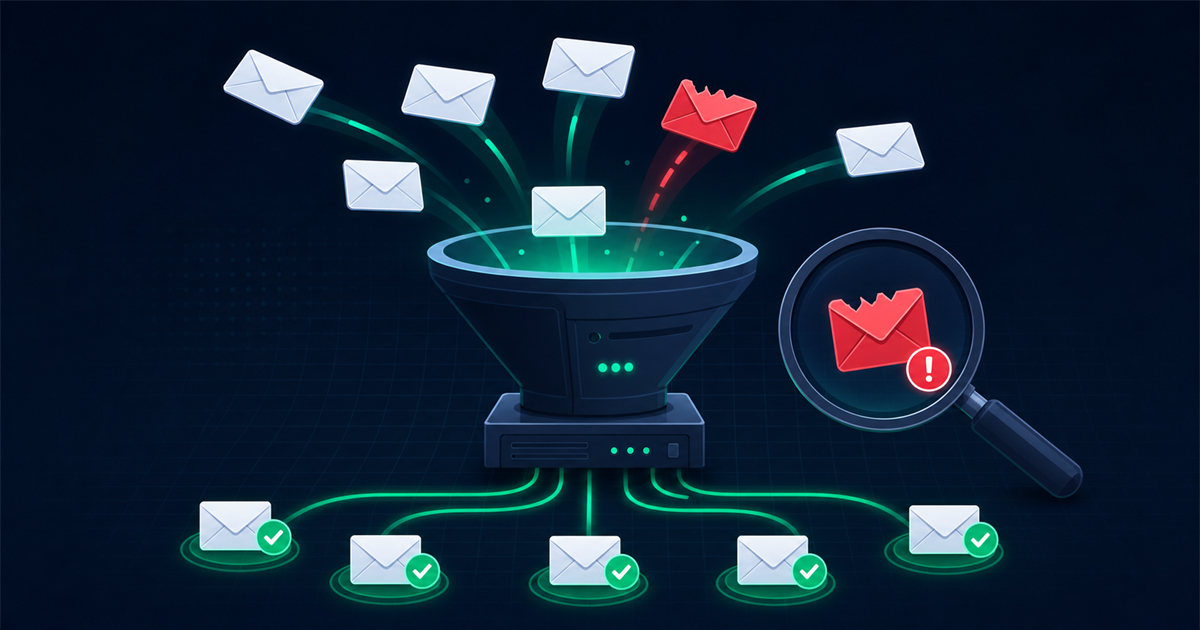
A catch-all email address is a domain setting that accepts mail sent to any address at that domain, even if the specific mailbox does not exist. This guide explains what catch-all (also called accept-all) domains are, why servers use them, why they make verification results come back as unknown or risky, and how to decide whether to send to them.
You will also learn how detection works behind the scenes and the practical best practices for handling catch-all addresses without hurting your deliverability.
What is a catch-all email address?
A catch-all email address is a domain configuration that receives every message sent to it, no matter what comes before the @ sign. So if a company sets example.com as catch-all, then sales@example.com, typo123@example.com, and anything-you-invent@example.com all get accepted by the mail server instead of being rejected.
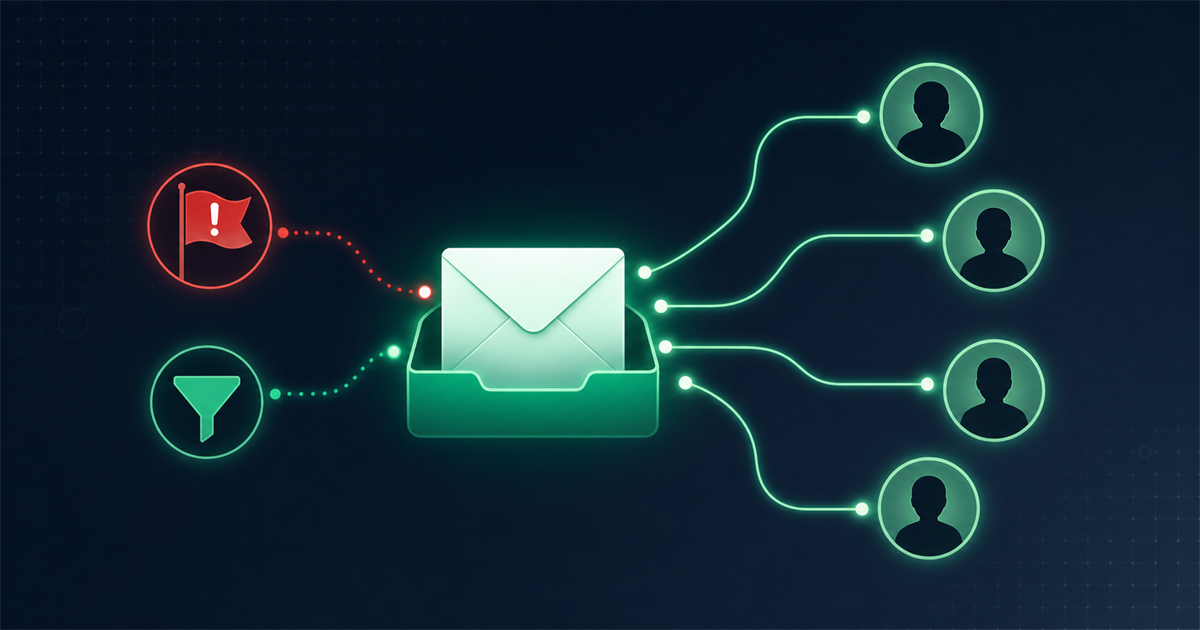
The domain administrator sets this up on purpose. Rather than defining each individual mailbox, the server is told to accept all incoming mail and route it somewhere, often a single catch-all inbox or a routing rule. From the outside, you cannot tell whether a given address maps to a real person or simply lands in a general bucket.
Why do mail servers use catch-all settings?
Servers use catch-all settings mainly to avoid losing messages that were sent to a slightly wrong address. It is a convenience feature for the receiving organization, not a signal about any single mailbox.
Common reasons an admin enables catch-all:
- Catch typos. If a customer emails "supprt@" instead of "support@", the message still arrives instead of bouncing.
- Flexible aliases. Small teams can hand out addresses like billing@ or press@ without creating a dedicated mailbox for each one.
- Simplicity. Managing one catch-all rule is easier than provisioning and maintaining many individual accounts.
- Lead capture. Some businesses want every possible inbound message, however it is addressed, to reach someone.
The trade-off is that catch-all domains also absorb spam and can hide the fact that a mailbox was never actually created.
Why does a catch-all make verification results "unknown" or "risky"?
A catch-all makes verification uncertain because the server says yes to every address, so a positive response no longer proves the specific mailbox exists. Normally, an email verifier connects to the recipient mail server and quietly checks whether it will accept mail for one exact address. On a normal domain, a real mailbox returns an accept response and a fake one returns a rejection, which gives a clear answer.
On a catch-all domain the logic breaks down. The server accepts the real address and the obviously fake test address with equal enthusiasm. Because the verifier cannot distinguish a genuine mailbox from a nonexistent one, it cannot honestly report the address as valid. Instead it returns a status such as unknown, accept-all, catch-all, or risky, which tells you the domain accepts everything and the individual mailbox cannot be confirmed.
This is why a good verification tool never inflates catch-all results into a false "valid". Honest handling of these edge cases is one of the things that separates a reliable checker from a careless one, and it is worth using a tool like Mailthentic that reports catch-all status clearly rather than pretending every address passed.
How does catch-all detection work?
Catch-all detection works by testing the domain with an address that should not exist and seeing whether the server still accepts it. If the made up address is accepted, the domain is treated as catch-all.
The typical process looks like this:
- Connect to the mail server. The verifier opens an SMTP conversation with the domain's mail exchanger and starts the handshake without actually sending a message.
- Probe a random address. It asks the server about a clearly fake, randomly generated address at the same domain, something no real person would own.
- Read the response. If the server rejects the random address, the domain distinguishes real mailboxes from fake ones, so a positive answer for your target address is trustworthy.
- Confirm with a second probe. If the server accepts the random address, the tool usually runs one or two more random probes to be sure. When multiple fake addresses are all accepted, the domain is confidently flagged as catch-all.
Because catch-all detection depends on the server's behavior at that moment, results can occasionally shift if the domain changes its configuration or applies greylisting delays.
Should you send to catch-all email addresses?
You can send to catch-all addresses, but treat them as medium risk rather than confirmed. Some catch-all addresses belong to perfectly real people, especially at businesses that use the setting for convenience, so blanket deleting them can throw away good contacts.
Here is a balanced way to think about it:
- Low volume, high value B2B. If a catch-all address is a named contact you gathered legitimately, such as jane.doe@company.com from a business card, it is usually worth sending to.
- Large cold lists. If a big chunk of a purchased or scraped list is catch-all, that is a warning sign. Sending broadly to unconfirmed addresses raises your bounce and complaint risk.
- Reputation stage. A new or fragile sending domain should be cautious, because it cannot absorb bounces. An established domain with strong reputation has more room to take a measured risk.
Best practices for handling catch-all addresses
Handle catch-all addresses with segmentation and caution instead of a simple keep-or-delete decision. The goal is to protect your sender reputation while not discarding real prospects.
- Segment them separately. Keep catch-all addresses in their own group so a possible bounce spike does not contaminate your main, fully verified sends.
- Warm up gently. Send to catch-all segments in smaller batches and watch bounce and complaint rates closely before scaling.
- Combine signals. Look at other data points such as role account status, engagement history, and whether the domain is a known business. A catch-all that is also a role address like info@ carries more risk.
- Prioritize engaged catch-alls. If a catch-all contact has opened or clicked before, that behavior is stronger proof of a real mailbox than any probe.
- Monitor and prune. After a send, remove any catch-all address that hard bounced and keep the ones that engaged.
Frequently asked questions
Is a catch-all email address the same as an invalid one?
No. An invalid address is confirmed not to exist, while a catch-all address simply cannot be confirmed either way because the server accepts everything. Invalid addresses should be removed, whereas catch-all addresses are uncertain and are best segmented and treated with caution.
Can email verification ever confirm a catch-all mailbox?
Not through standard SMTP probing alone, because the server accepts real and fake addresses identically. The most reliable confirmation comes from real engagement, such as the contact opening or clicking a past email, or from the recipient confirming through a double opt-in.
Are catch-all domains common?
Yes, they are fairly common, particularly among small and midsize businesses and organizations that run their own mail on platforms that make catch-all easy to enable. Large consumer providers like Gmail generally do not behave as catch-all, so you see them most often on custom company domains.
Will sending to catch-all addresses hurt my deliverability?
It can if you send to many of them at once and a large share turn out to be invalid, because the resulting bounces damage your sender reputation. Sending selectively to segmented, higher confidence catch-all addresses in small batches keeps the risk manageable.
Final thoughts
A catch-all email address is not a verdict on any single mailbox, it is a property of the whole domain that accepts everything. That is exactly why honest verification reports it as unknown or risky instead of a false valid. Understand why servers use catch-all, lean on multi-probe detection to identify these domains, and then segment and send carefully. Handled with a little discipline, catch-all addresses become a manageable gray area rather than a threat to your inbox placement.

Comments (0)
No comments yet. Be the first to share your thoughts!
Leave a Comment
Your email address will not be published. Required fields are marked *