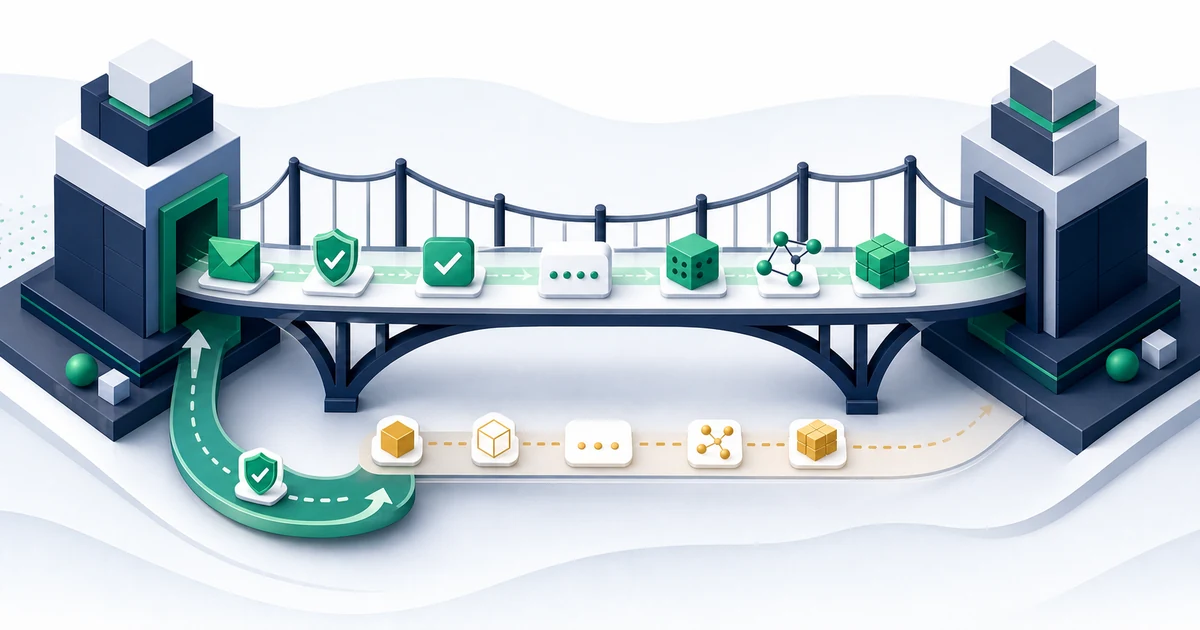

Changing an email verification provider is a data and software migration, not a credential swap. Status meanings, timeouts, rate controls, exports, and failure behaviour may differ even when two services use familiar labels. A safe cutover builds an internal contract, tests representative records in parallel, and keeps a usable rollback path.
Inventory current workflows
Find every place the current service is used: signup forms, imports, scheduled cleaning, CRM actions, support tools, notebooks, and manual procedures. Search code, secrets stores, automation platforms, dashboards, and billing records. Name an owner and business consequence for each workflow.
Document volumes, peaks, latency expectations, data sent, retention, downstream fields, and what happens during an outage. Undocumented manual use can be as important as production API traffic.
Export old data
Before access ends, export result history, job metadata, billing records, suppression-related mappings, and audit information permitted by the contract. Store it securely with a data dictionary and deletion date. Do not copy more personal data merely because an export button exists.
Record which values are provider observations and which are your organisation's decisions. A manual override should not be mistaken for a vendor result during migration.
Map status names
Create an internal set of stable categories such as usable evidence, reject, review, retry, and integration error. Map both providers into it. Do not assume that identical words mean identical checks or thresholds.
Keep the raw provider status, reason, service name, version if available, and timestamp for audit. Downstream systems should consume the internal action, not raw labels.
Compare result definitions
Read current documentation and ask how catch-all, disposable, role-based, temporary, and unknown results are defined. Compare whether domain-only and mailbox-level evidence are separated. Note what the service cannot determine.
A small disagreement sample is more informative than a single headline agreement rate. Review cases by reason and intended business action. Never invent competitor features or claim one result is correct without independent evidence.
Change API authentication safely
Store new credentials in a secrets manager, apply least privilege, and rotate them after testing. Do not place keys in source control, client-side code, screenshots, or general logs. Confirm separate credentials and quotas for test and production environments.
Keep the old credential active through the rollback window if the contract and security policy permit it. Set an explicit revocation date.
Review endpoint changes
Use the provider's current documentation rather than adapting an old URL by guesswork. Compare methods, payload size, encoding, authentication headers, response formats, status codes, and batch behaviour. Validate schemas strictly enough to detect unexpected changes but tolerate harmless new fields.
Wrap the provider in one adapter. Application code should ask an internal verification service for a decision, leaving provider-specific details at the boundary.
Plan for rate limits
Measure steady and burst traffic. Learn how limits are communicated, whether quotas apply per account or credential, and how long clients should wait. Put queue and concurrency controls in your system rather than relying on accidental request timing.
Rate-limit responses are not address results. They belong in the integration-error path and must not mark records invalid.
Rebuild error handling
Classify failures into retryable transport or service conditions, non-retryable request errors, authentication or configuration incidents, and valid verification outcomes. Set timeouts and a bounded retry policy with jitter. Preserve a dead-letter or review route for work that exhausts retries.
Test malformed JSON, missing fields, slow responses, connection resets, quota responses, and permission errors. Happy-path testing will not reveal whether signup stays usable during an incident.
Check webhooks
If bulk jobs complete through webhooks, verify signatures, timestamps, replay protection, event identifiers, and retry behaviour. Process duplicate delivery idempotently. Fetch sensitive result files through authenticated server-side calls rather than trusting arbitrary callback URLs.
Monitor callback age and reconcile jobs periodically in case an event is lost. A webhook is a notification, not the only record of truth.
Update CRM mappings
Review field types, pick-list values, automations, filters, scoring, and dashboards. Add provider and checked-at fields if they are missing. Preserve consent and suppression independently from verification status.
Test updates and new records separately. Disable or isolate workflows that could send messages during a migration sample.
Run parallel tests
Use a representative, authorised sample containing consumer and business domains, known invalids, catch-all cases, role addresses, disposable signals, internationalised examples, and expected temporary failures. Protect the data and delete test copies on schedule.
Compare decisions, latency distributions, unknown rates, errors, and operational effort. Investigate disagreements rather than choosing the more convenient answer. Do not send mail merely to manufacture a benchmark unless that activity is authorised and expected.
Prepare a rollback plan
Define the conditions that trigger rollback, who can decide, how traffic switches, which queued jobs remain compatible, and how results produced during the attempt are identified. Database changes should be backward compatible through the window.
Rollback is not complete until monitoring confirms the old path is healthy and no records were lost or double processed.
Cutover checklist
- Freeze mapping and configuration changes.
- Confirm credentials, quotas, monitoring, and support contacts.
- Deploy the adapter behind a feature flag.
- Send a small percentage of eligible traffic to the new service.
- Compare errors, latency, and outcome distributions.
- Increase gradually with an owner watching each stage.
- Reconcile queues and batch jobs.
- Complete the rollback window before revoking old access.
- Delete unnecessary exports and rotate migration credentials.
- Update runbooks, diagrams, and vendor records.
The familiar provider names used in searches, including ZeroBounce, NeverBounce, Hunter, Bouncify, and Mailboxlayer, do not change this method. Current contracts and documentation must be reviewed directly; this article makes no feature comparison among them.
Teams considering another implementation can review Mailthentic's API overview. The portable architecture is the more important choice: stable internal decisions, one provider adapter, controlled tests, and a rollback that has been rehearsed.
Close the old service deliberately
After the rollback window, revoke credentials, stop scheduled jobs, remove webhook routes, cancel unused plans, and confirm contractual deletion of retained inputs where applicable. Search again for the old hostname and secret names. An abandoned integration can continue sending personal data or create an unnoticed security exposure.
Archive only the documentation and evidence needed for audit. Update the data-flow map, incident runbook, vendor register, and onboarding material so a future engineer does not restore an obsolete path from an old example.
Review privacy and procurement
Before sending production data, confirm the contract, processing purpose, retention, deletion mechanism, subprocessors, processing locations, security contacts, and incident terms with the appropriate internal owners. The technical test account should not become an informal production route while that review is incomplete.
Compare what fields each workflow sends. A new provider should not receive names, CRM notes, or campaign attributes when an address and opaque job ID are sufficient. Update records of processing and data-flow diagrams where required.
Train the people who use results
Operations, support, sales, and developers need the new internal categories, not a tour of provider marketing labels. Explain how to recognise an integration error, when to retry, and how to record an override. Give support a path for legitimate users affected by a rule.
Run a tabletop incident before cutover: the new service times out, unknown rates rise, and a batch webhook is delayed. Confirm who opens the breaker, who communicates, and how queued records are reconciled.
Capture questions that the exercise exposes and update the runbook before real traffic moves. A successful rehearsal always ends with assigned actions, deadlines, and another review of the rollback criteria.



Comments (0)
No comments yet. Be the first to share your thoughts!
Leave a Comment
Your email address will not be published. Required fields are marked *