

Bad email data costs more than the fee for messages that bounce. It consumes sales attention, creates duplicate work, distorts reports, and causes automations to act on the wrong record. A useful business case counts these operational effects without pretending that every avoided error becomes revenue.
Wasted send costs
Some sending platforms charge by contacts, volume, or plan tier. Invalid and duplicate addresses can therefore consume capacity. Calculate the avoidable share using actual contract terms and measured list composition, not a generic unit price.
Do not count all inactive recipients as bad data. A valid, consented address can simply be disengaged, which is a different policy question.
Wasted sales time
A representative may research, personalise, send, wait, investigate a failure, and search for a replacement address. Estimate time from a sample of real workflows. Separate work that verification could prevent from work caused by poor targeting or outdated employment data.
Use a loaded hourly cost if the calculation is for planning, and state what it includes. Avoid translating every saved minute directly into booked revenue.
CRM storage
Duplicate and unusable records can push a database into a higher tier, complicate backups, and slow administration. The direct cost is the incremental plan or infrastructure effect. The larger cost may be uncertainty about which record is authoritative.
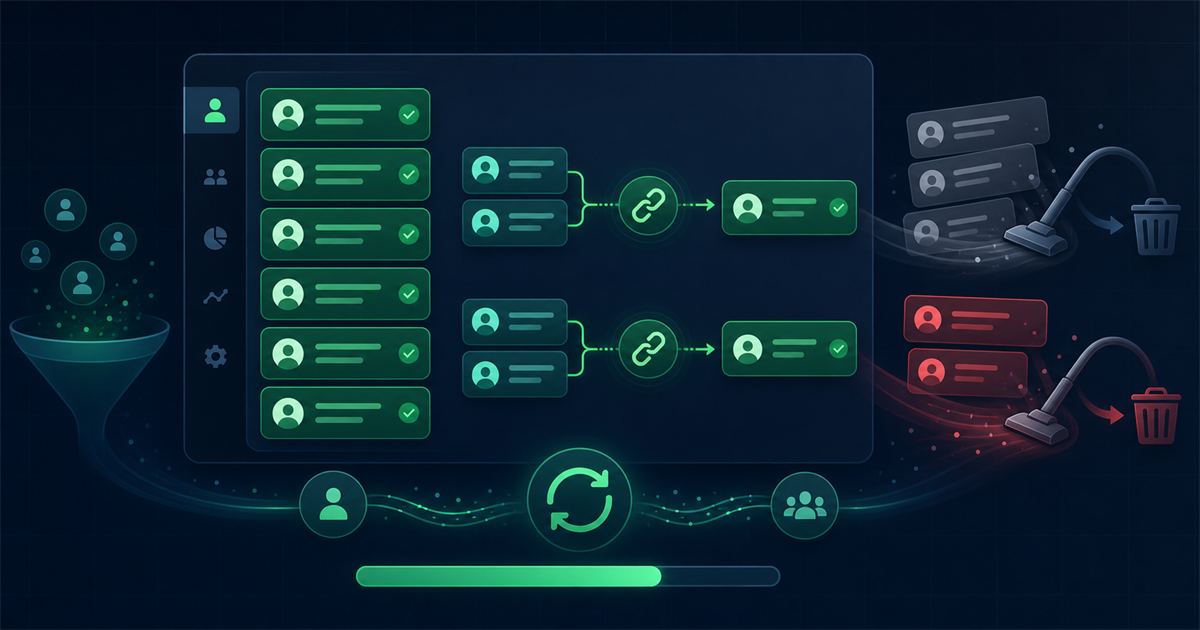
Verification alone does not deduplicate a CRM. Identity rules, source IDs, merge policy, and suppression preservation are still required.
Automation errors
A bad address can trigger retries, tasks, lead-routing branches, and follow-up sequences. A duplicate can trigger the same journey twice. Inventory the systems touched after a record enters, then count real incident handling and corrective work.
Some automation failures are software defects. Do not assign their full cost to address quality merely because an email field was involved.
Bounce handling
Hard bounces should update suppression promptly. Soft failures need categorisation and limits. Operations teams spend time investigating spikes, reconciling provider reports, and correcting customer records. Use support and incident data to estimate this cost.
Verification can reduce avoidable errors but cannot prevent every bounce. Mail systems and accounts change after a check.
Reporting distortion
Duplicate, invalid, or misassigned records alter denominators and funnel counts. Campaign rates, lead velocity, territory performance, and conversion attribution can all look different. The cost is not the numerical distortion itself, but decisions made from it and analyst time spent correcting it.
Document which metrics use contacts, unique people, accounts, or deliverable destinations. A clean definition often matters as much as a cleaner field.
Sender-reputation exposure
Sending to known bad data can contribute to poor outcomes, but reputation is also shaped by authentication, permission, complaints, content, volume patterns, and recipient engagement. Avoid assigning a guaranteed monetary value to verification.
Model exposure as a risk range and list the controls that verification does not cover.
Duplicate records
Duplicates split activity histories, create conflicting ownership, and may cause repeated communication. Estimate the frequency and average correction time. Be careful when shared addresses are legitimate, since one email does not always equal one person or account.
A merge should preserve the strongest consent, suppression, and provenance evidence rather than selecting the fullest marketing profile.
Cost per usable contact
Divide the full acquisition and preparation cost by contacts that remain eligible for the intended use. Include source purchase or event cost only when appropriate, staff preparation, verification, deduplication, and import work. Define usable as a combination of technical evidence, permission, and business relevance.
This measure is more honest than cost per row because it exposes low-quality sources without claiming that every usable contact will convert.
Example calculations
| Component | Formula | Evidence needed |
|---|---|---|
| Send capacity | Avoidable records multiplied by actual marginal rate | Contract and measured segment |
| Sales rework | Affected records multiplied by sampled minutes and loaded rate | Workflow sample |
| Incident handling | Events multiplied by average resolution cost | Ticket or incident history |
| Verification programme | Service, engineering, operations, and review | Invoices and time estimates |
| Net operating effect | Avoided measured cost minus programme cost | Comparable periods and caveats |
For example, a team can sample one month of failed-contact work, measure the portion tied to errors detectable before use, and compare it with a pilot's service and labour cost. Present a low, central, and high case rather than one precise forecast.
Limits of ROI estimates
Historical periods differ, avoided incidents are hard to observe, and better targeting may occur alongside verification. Credits may expire, staff time may not become cash savings, and improved deliverability cannot be guaranteed. Record every assumption and avoid double counting the same failure as send waste, sales time, and reputation loss.
A pilot should measure operational outcomes such as correction rate, review volume, retry rate, and staff time. Revenue attribution needs a stronger design.
Decision framework
- Define the workflow and error that could be prevented.
- Measure baseline frequency from your own data.
- Estimate direct and labour costs conservatively.
- Include implementation, security, review, and maintenance.
- Run a limited pilot with a comparison where practical.
- Review false blocks, unknown results, and support impact.
- Continue only where measured value exceeds total burden.
Mailthentic publishes current verification pricing for teams building their own estimate. Prices are only one input. A defensible case uses actual workflow evidence and describes uncertainty instead of promising savings.
Avoid double counting
One invalid record may create a paid send, a bounce event, and five minutes of sales rework. Those can be separate costs, but a broad incident estimate may already include the labour. Draw a simple path from source error to consequence and attach each cost once. State whether salaries are treated as recoverable cash, available capacity, or neither.
Compare like periods and normalise for list size, campaign mix, and staffing changes. If a pilot also introduces deduplication and new consent rules, report the combined programme effect rather than attributing every change to verification.
Keep the calculation reviewable. An analyst who was not part of the project should be able to trace every input to a contract, time sample, ticket report, or clearly labelled assumption. Update the model when those inputs change.
Design a useful pilot
Select one bounded workflow with measurable baseline errors, such as a consented CRM import prepared by the same operations team each month. Define the eligible records, handling policy, review capacity, and observation period before starting. Avoid choosing only the messiest file, since that can exaggerate routine value.
Track service expense, staff preparation, correction prompts, unknown results, review minutes, blocked legitimate records, and downstream incidents. Compare with a similar prior batch or a controlled portion when practical. Protect personal data and do not send unexpected messages merely to determine an outcome.
Value capacity honestly
If automation saves ten staff hours, the organisation may gain capacity rather than cash. State what the team will do with that time and whether it delays hiring, reduces overtime, or simply improves service. Calling all capacity a direct saving overstates the case.
The same discipline applies to storage and plan tiers. Removing records saves money only when it changes an actual bill or future purchase. Otherwise, report operational headroom separately.
Include false decisions
A strict rule can reject real customers, create support contacts, or delay sales follow-up. Estimate those costs from observed overrides and confirmations. Unknown and catch-all results may require manual work that reduces the apparent benefit of cheap automated checks.
Use ranges when the consequence is uncertain. A programme that looks attractive only when false blocks are assumed to cost nothing needs a better design.
Review the case after launch
Replace assumptions with measured values after the first operating cycle. Check whether data sources improved, staff actually used the result fields, and retry queues stayed under control. Stop checks that do not change decisions.
Revisit the model when pricing, volumes, CRM contracts, or policy changes. An approved business case is a decision record, not a permanent promise of return.
Comments (0)
No comments yet. Be the first to share your thoughts!
Leave a Comment
Your email address will not be published. Required fields are marked *