
Introduction
The Flight Tracking System Market is expanding rapidly as the aviation industry increasingly relies on real-time aircraft monitoring, digital communication, and advanced data analytics to improve operational efficiency and passenger safety. Flight tracking systems enable airlines, airports, air traffic management authorities, and aviation service providers to monitor aircraft positions, optimize flight routes, reduce operational delays, and enhance fleet management.
Recent industry developments include satellite-based tracking technologies, Artificial Intelligence (AI)-driven analytics, cloud-based aviation platforms, and predictive maintenance solutions. As global air traffic continues to recover and aviation digitalization accelerates, the Flight Tracking System Market is expected to experience sustained growth through 2034.
Flight Tracking System Market Snapshot
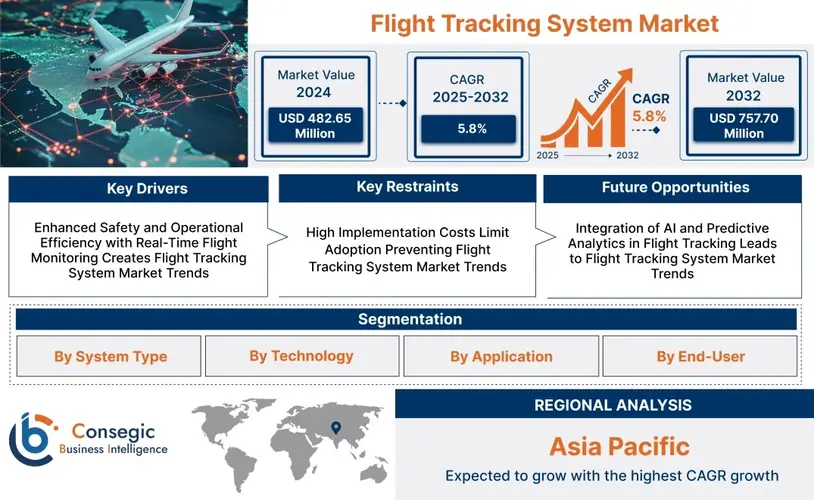
Flight Tracking System Market size is estimated to reach over USD 757.70 Million by 2032 from a value of USD 482.65 Million in 2024 and is projected to grow by USD 502.04 Million in 2025, growing at a CAGR of 5.8% from 2025 to 2032.
Market Overview
Flight tracking systems combine satellite communication, GPS technology, radar, cloud computing, and advanced software to provide continuous aircraft monitoring throughout flight operations.
Industry Importance
Enhances aviation safety and operational visibility
Improves air traffic management efficiency
Supports fleet optimization
Enables real-time flight monitoring
Strengthens regulatory compliance
Growth Outlook
The market is projected to grow steadily through 2034, driven by increasing commercial aviation activities, modernization of air traffic management systems, and digital transformation across the aerospace sector.
Key Applications
Commercial aviation
Military aviation
Business aviation
Cargo transportation
Air traffic management
Aircraft fleet monitoring
End-User Industries
Airlines
Airports
Air traffic control authorities
Defense organizations
Aviation technology providers
Aircraft operators
Read Full Report @ Flight Tracking System Market Growth Drivers
Several factors continue driving the expansion of the market.
Growing Demand for Aviation Safety
Airlines and regulatory authorities increasingly require continuous aircraft tracking to improve operational safety, emergency response capabilities, and regulatory compliance.
Technological Advancements
Satellite communications, Automatic Dependent Surveillance–Broadcast (ADS-B), cloud computing, GPS technologies, and AI-powered analytics continue enhancing tracking accuracy and operational efficiency.
Government Aviation Modernization Programs
Governments worldwide are investing in next-generation air traffic management systems, digital aviation infrastructure, and satellite navigation technologies.
Rising Industry Investments
Investments in smart airports, aviation software platforms, and connected aircraft technologies are supporting long-term market growth.
Increasing Air Passenger Traffic
The continued expansion of global commercial aviation and cargo transportation increases demand for advanced flight monitoring systems.
Infrastructure Development
Airport modernization, communication network expansion, and satellite infrastructure improvements further strengthen market opportunities.
Flight Tracking System Market Emerging Trends
Several transformative technologies are shaping the future of the industry.
Artificial Intelligence (AI) improves flight prediction and operational decision-making.
Machine Learning (ML) enhances route optimization and anomaly detection.
Automation streamlines air traffic management operations.
Digital transformation enables integrated aviation ecosystems.
Cloud technologies support centralized flight data management.
IoT integration enables real-time aircraft monitoring and equipment diagnostics.
Data analytics improves operational planning and airline efficiency.
Predictive maintenance minimizes aircraft downtime.
Smart aviation platforms provide end-to-end operational visibility.
Sustainability initiatives optimize flight paths to reduce fuel consumption and emissions.
Technology Landscape
Technology continues to redefine the Flight Tracking System Market through innovation across hardware, software, and communication systems.
Key advancements include:
Satellite-based aircraft tracking
AI-powered flight analytics
Cloud-based aviation platforms
Advanced ADS-B technologies
Real-time fleet management software
IoT-enabled aircraft monitoring
Predictive maintenance solutions
Robotics-assisted manufacturing for aviation electronics
Advanced communication networks
High-performance aerospace sensors
Research and development investments continue improving tracking accuracy, cybersecurity, system integration, and operational reliability.
Regional Analysis
North America
North America dominates the market due to its advanced aviation infrastructure, widespread adoption of digital aviation technologies, strong airline presence, and continuous investments in air traffic modernization.
Europe
Europe benefits from modern aviation regulations, smart airport initiatives, collaborative airspace management programs, and increasing investments in sustainable aviation technologies.
Asia-Pacific
Asia-Pacific is expected to experience the fastest growth owing to expanding airline fleets, airport development projects, rising passenger traffic, and government investments in aviation modernization.
Latin America
Increasing commercial aviation activity, airport expansion, and modernization of aviation infrastructure continue driving regional market growth.
Middle East & Africa
Growing investments in international airports, aviation hubs, and smart transportation infrastructure create promising opportunities throughout the region.
Investment Opportunities
The Flight Tracking System Market presents several high-growth investment opportunities.
AI-powered aviation analytics
Satellite communication systems
Smart airport technologies
Cloud-based aviation software
IoT-enabled aircraft monitoring
Digital air traffic management platforms
Aviation cybersecurity solutions
Sustainable aviation technologies
Organizations investing in digital transformation, intelligent aviation systems, and next-generation communication technologies are expected to strengthen their competitive advantage.
Competitive Environment
Competition within the market centers on innovation, digital integration, and operational efficiency.
Key business strategies include:
Product innovation
Strategic partnerships
Aviation software development
Research and development investments
Technology acquisitions
Cloud platform integration
Capacity expansion
AI-enabled flight management solutions
Companies continue focusing on advanced analytics, cybersecurity, regulatory compliance, and seamless integration with modern aviation infrastructure.
Key Statistics
Global air traffic growth continues increasing demand for advanced flight tracking systems.
AI and Machine Learning are improving operational efficiency and predictive analytics.
Smart airport investments support broader adoption of digital aviation platforms.
Satellite communication technologies enhance global aircraft visibility.
IoT-enabled monitoring improves aircraft maintenance planning.
Cloud-based aviation platforms simplify operational data management.
Sustainability initiatives encourage optimized flight routes and reduced emissions.
Future Outlook
The Flight Tracking System Market is expected to experience strong growth through 2034 as digital aviation, smart airport infrastructure, and connected aircraft technologies continue expanding worldwide. Artificial Intelligence, Machine Learning, automation, cloud technologies, predictive maintenance, IoT integration, and advanced data analytics will further improve aircraft monitoring, operational efficiency, and airspace management.
Future innovations in satellite communications, cybersecurity, digital air traffic management, smart manufacturing, and sustainable aviation solutions will strengthen market growth while supporting safer and more efficient global aviation operations.
Frequently Asked Questions (FAQs)
Q1. What is the Flight Tracking System Market?
The Flight Tracking System Market includes technologies and software that enable real-time aircraft monitoring using GPS, satellite communication, radar, and cloud-based platforms. These systems improve flight visibility, operational efficiency, fleet management, and aviation safety for airlines and aviation authorities.
Q2. What factors are driving the market growth?
The market is driven by increasing air traffic, aviation digitalization, government modernization programs, satellite communication advancements, AI-powered analytics, cloud technologies, smart airport development, predictive maintenance, and growing demand for enhanced flight safety.
Q3. Which region dominates the Flight Tracking System Market?
North America currently leads the Flight Tracking System Market due to its advanced aviation infrastructure, strong airline industry, early adoption of digital aviation technologies, significant investments in air traffic modernization, and robust aerospace ecosystem.
Q4. What are the latest trends in the Flight Tracking System Market?
Major trends include AI-driven flight analytics, Machine Learning-based route optimization, cloud aviation platforms, IoT-enabled aircraft monitoring, predictive maintenance, digital air traffic management, cybersecurity enhancements, satellite-based tracking, and smart aviation infrastructure.
Q5. What opportunities are expected by 2034?
By 2034, opportunities are expected in AI-powered aviation analytics, smart airport technologies, satellite tracking systems, cloud-based aviation platforms, IoT-enabled aircraft monitoring, aviation cybersecurity, sustainable aviation solutions, and next-generation digital air traffic management.
Conclusion
The Flight Tracking System Market is poised for sustained growth through 2034, driven by the rapid digital transformation of the aviation industry and increasing demand for real-time aircraft monitoring. Advancements in Artificial Intelligence, Machine Learning, automation, cloud computing, IoT integration, predictive maintenance, smart aviation technologies, and advanced data analytics are reshaping flight operations and air traffic management. With continued investments in smart airports, satellite communications, sustainable aviation, and aviation cybersecurity, the Flight Tracking System Market will remain a critical component of the global aerospace ecosystem, supporting safer, more efficient, and highly connected air transportation.
About Us
At Consegic Business Intelligence Pvt. Ltd., we empower organizations with actionable market intelligence, strategic insights, and data-driven research solutions that support informed business decision-making. Our comprehensive market research reports provide in-depth analysis of industry trends, competitive landscapes, emerging opportunities, and future growth prospects across diverse sectors.
Comments (0)
No comments yet. Be the first to share your thoughts!
Leave a Comment
Your email address will not be published. Required fields are marked *