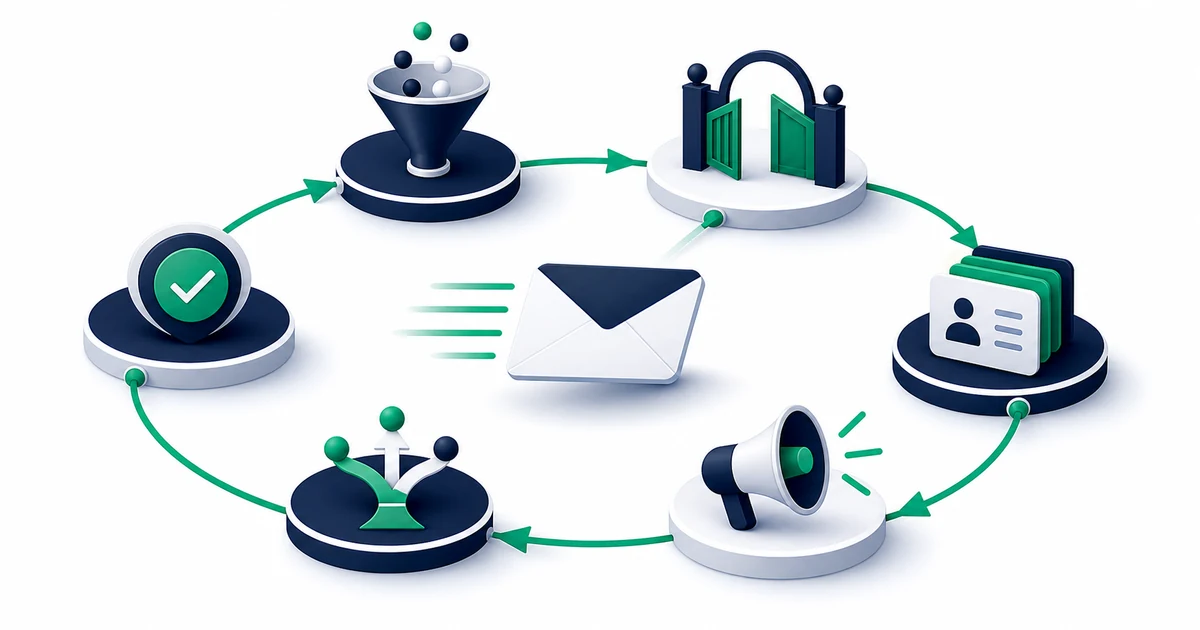

Email quality is easiest to manage when it is treated as part of the customer data lifecycle, not as a cleanup event before a large campaign. An address enters through a form, import, sales conversation, or support process. It may then be copied into several systems, enriched, suppressed, corrected, and eventually deleted. Verification should appear at the points where evidence can prevent a costly mistake or resolve uncertainty.
Start at the point of collection
The collection interface can prevent basic errors before any external check. Trim accidental outer spaces, retain the user's original value for audit where appropriate, and run standards-aware syntax validation. Do not silently rewrite a domain because a guessed correction can send sensitive mail to the wrong person.
Explain why the address is needed. Verification does not create consent and cannot replace a confirmation link where ownership matters. Collecting less data, with a clear purpose, usually improves both privacy and quality.
Form submissions
Public forms face typos, bots, disposable addresses, shared inboxes, and outages in external services. Use layered controls: local syntax checks, rate controls, optional verification, and confirmation where the user must prove access. A risky or unknown result can trigger a warning or review rather than a hard block.
Record the reason for a decision, not only a boolean. That allows support staff to explain what happened and enables the policy to change without losing the original signal.
CRM imports
An import is a high-leverage checkpoint because one file can introduce thousands of errors. Preserve source IDs, consent fields, suppression states, and the original address. Normalise field formatting, identify duplicates, and verify only the column that needs it. Map results into new fields before deciding what to include.
Reconcile the output row count with the source. Invalid, blank, and malformed records still need an accounted-for disposition. Deleting them from the working file makes the audit incomplete.
Sales prospecting
Sales data often arrives through enrichment, research, events, or manual entry. A positive verification result does not establish that contacting the person is lawful, relevant, or expected. Keep provenance, collection date, territory, and applicable objection or suppression information beside the address.
Use verification to prioritise review and reduce avoidable errors. Do not use it to override a do-not-contact request or to revive a record whose retention period has ended.
Newsletter subscriptions
At subscription, the important questions are whether the value is usable, whether the person controls it, and whether consent is valid. A confirmation message can establish control more directly than SMTP probing. Verification can still catch malformed domains or inform a gentle correction prompt.
Store the consent event separately from verification status. If an address later becomes invalid, the history may still be needed for compliance, even though the address should be suppressed from sends.
Customer accounts
Account email addresses affect security, receipts, recovery, and service notices. Changes should require authentication and, when appropriate, confirmation through the new inbox. A verifier cannot prove that the person requesting a change owns either address.
Do not block access solely because a background recheck becomes unknown. Use account activity, confirmed changes, delivery events, and support evidence. High-impact changes need a security design, not simply a verification score.
Data enrichment
Enrichment can improve routing and segmentation, but it also creates new provenance and accuracy obligations. Keep supplied facts separate from inferred facts and provider flags. Record when each field was obtained and which system owns corrections.
A role-based or disposable classification can change as domains change hands or providers evolve. Treat these values as observations with timestamps, not permanent truths about a person.
Reverification
Recheck when the age of the evidence and consequence of error justify it. Useful triggers include a long-dormant record returning to use, a planned high-volume send, repeated soft failures, or migration from an old system. Rechecking every record on a short calendar wastes resources and expands data processing without a decision need.
Define which prior results can be reused, how long, and which events invalidate them. Always preserve the last check time and provider or method.
Suppression
Suppression is not the same as deletion. A minimal suppression record can prevent a hard-bounced, unsubscribed, or objecting address from being reimported later. Verification results must never erase unsubscribe or complaint state. Consent and sending eligibility are governed by separate evidence.
Restrict access and retain only what is needed. A cryptographic representation may suit some matching needs, but its design requires care because common email addresses can be guessed.
Assign team responsibility
| Lifecycle point | Likely owner | Required evidence |
|---|---|---|
| Signup | Product and engineering | Decision rule, latency, user message |
| CRM import | Revenue operations | Source ID, mapping, reconciliation |
| Campaign use | Marketing operations | Consent, suppression, freshness |
| Account change | Security and support | Authentication and confirmation |
| Retention | Privacy or data governance | Purpose and deletion schedule |
A sample lifecycle
- Collect the minimum address with a clear purpose.
- Run local validation and, when justified, a time-bounded verification check.
- Ask for confirmation when ownership matters.
- Store the result, method, and time separately from consent.
- Propagate corrections and suppression states through controlled integrations.
- Recheck only when age or an operational event changes the risk.
- Delete or minimise records when their purpose expires.
Governance checklist
- Document what each result means and does not mean.
- Name owners for mapping, overrides, retries, and incidents.
- Keep consent and suppression independent of technical validity.
- Minimise columns sent to an external service.
- Log decisions without exposing full addresses broadly.
- Test failure paths before making a service part of signup.
- Review retention for inputs, results, and exports.
Teams evaluating a managed workflow can review Mailthentic's CRM verification overview. The lifecycle design should remain portable: internal policy owns the decision, while a provider supplies time-bound evidence.
Measure the lifecycle, not a headline score
Useful measures include how many people correct a likely typo, how many uncertain signups later confirm, how long import-review queues remain open, and how often suppressed records attempt to re-enter. These reveal whether the process is working. A single percentage labelled list quality can hide invalid records, expired consent, duplicates, and unresolved outages behind one number.
Review false blocks and support appeals as seriously as prevented errors. The goal is dependable customer data with proportionate friction, not the highest possible rejection rate.
Manage changes to the policy
Treat a new status mapping or block rule like a product change. Record the proposal, evidence, affected workflows, owner, and rollback. Test it against an authorised historical sample or in observe-only mode before it controls users. A rule that is sensible for newsletter imports may be harmful when reused for account recovery.
Version the mapping stored with each decision. Without a version, teams cannot explain why two identical provider results produced different actions months apart. Notify support and operations before release, and review outcomes after enough normal traffic has passed to expose unintended effects.
Include deletion and vendor-exit procedures in the same change record. If a provider is replaced, the organisation should know which cached results remain usable, how raw exports will be removed, and which credentials, webhooks, or scheduled jobs must stop. Lifecycle governance includes all the tools that process the data, not only the records visible in the CRM.



Comments (0)
No comments yet. Be the first to share your thoughts!
Leave a Comment
Your email address will not be published. Required fields are marked *